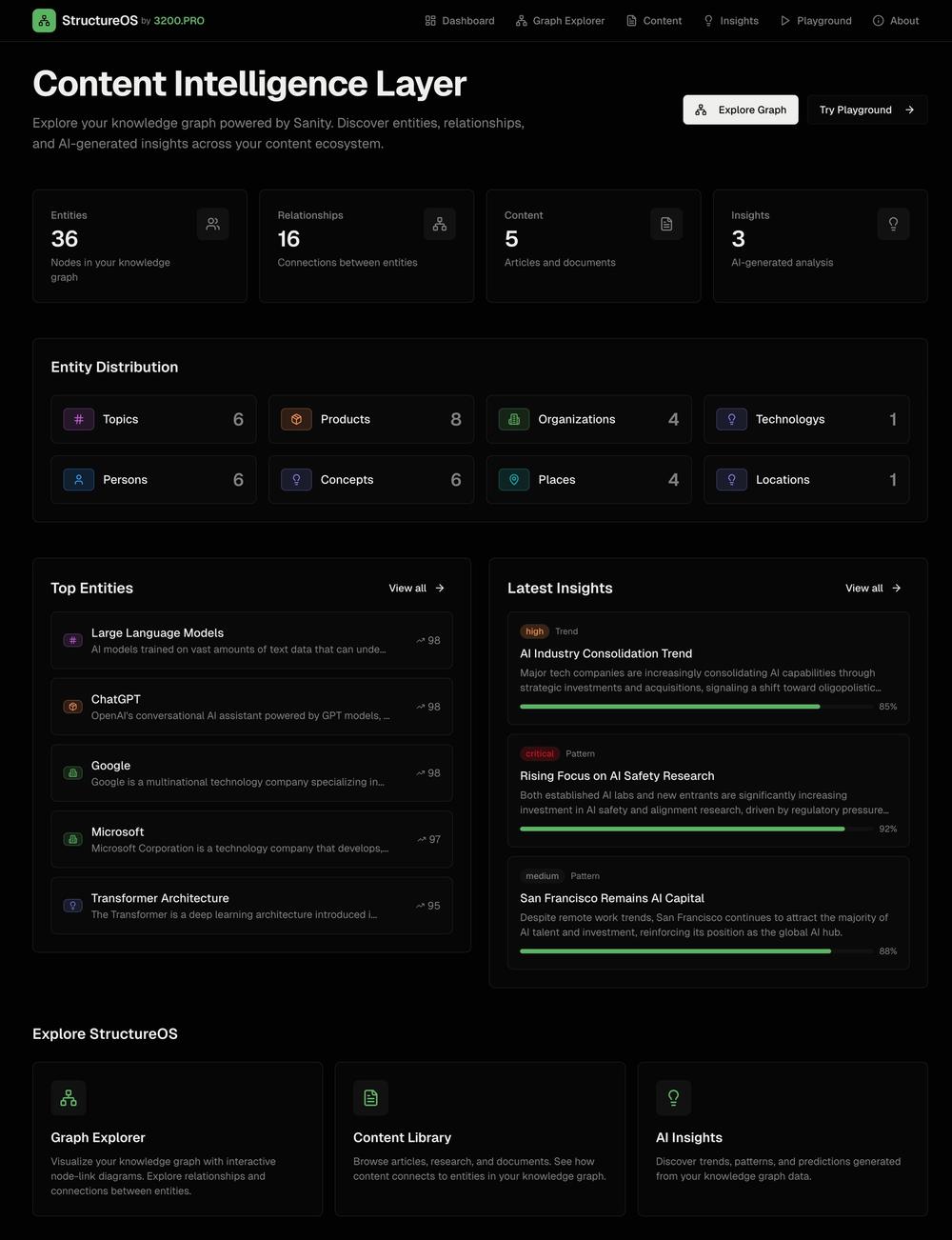
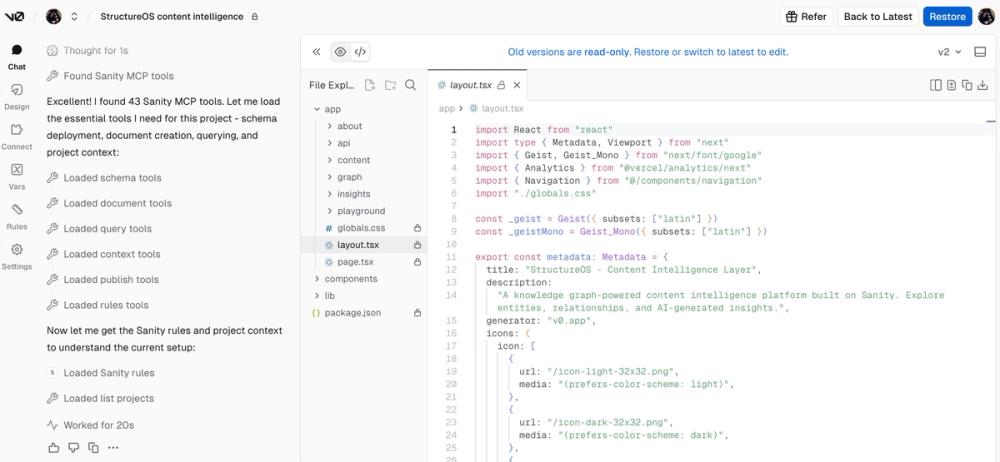
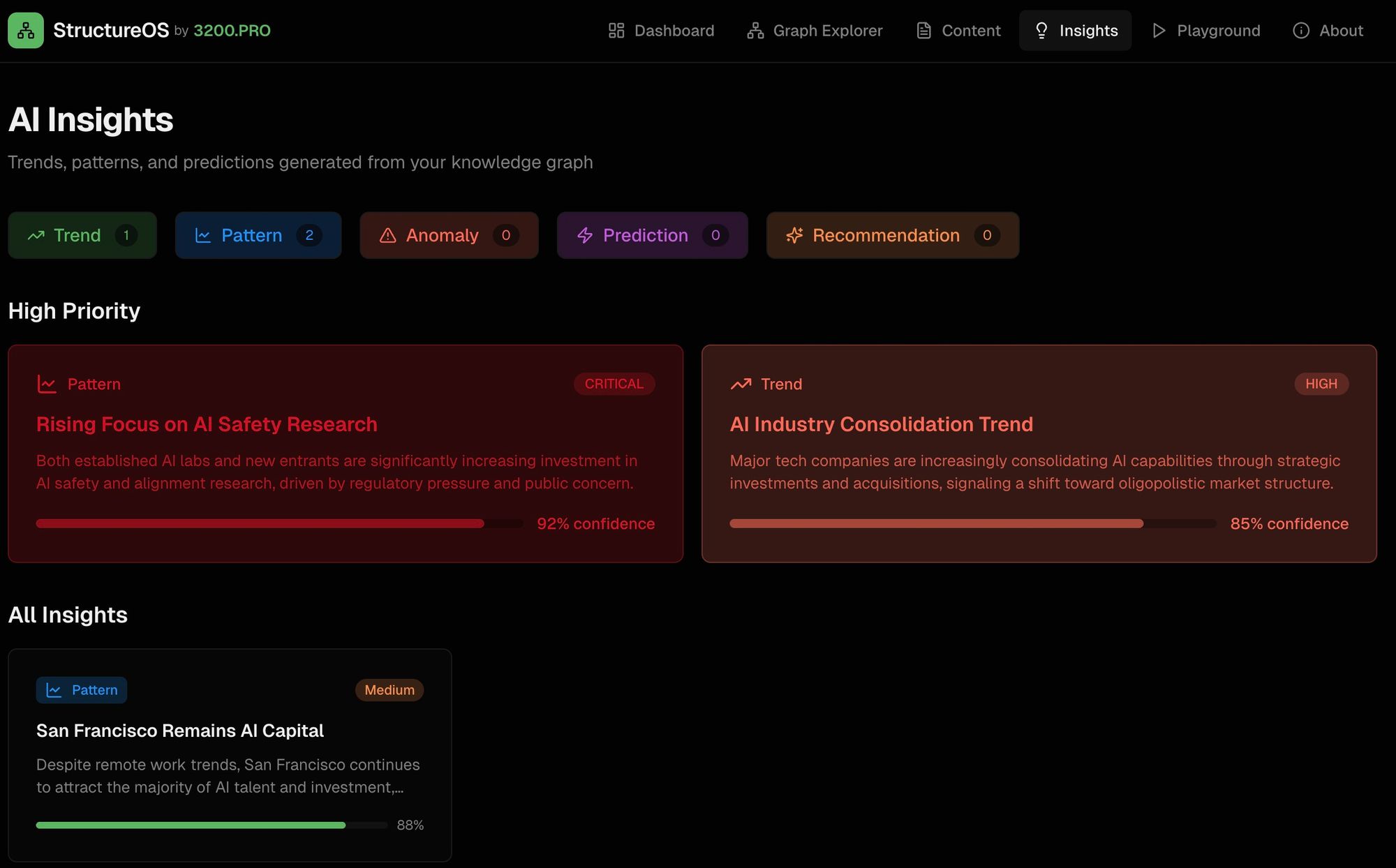
StructureOS is a production-deployed product that shows how structured content and explicit relationships can serve as an intelligence layer for any website or application. The project was built entirely through v0 prompts, with no manual code changes or studio edits during production.
⚠️ Relationship modeling is currently at 50% completion, with most connections established from the initial scope prompts. Additional revision prompts were tested to validate iterative updates and ongoing refinements.
Application Architecture
The application is built using Next.js App Router and deployed to production.
Server components and query-driven rendering are used to keep performance high and data flow predictable. All content is created and managed through Sanity MCP. No Sanity Studio interface is required for the core experience.
The entire build process is executed through v0 agent chat, demonstrating how structured intent can generate full-stack applications when content models are well defined.
Why This Approach Matters
As search, AI, and content systems increasingly depend on structured understanding rather than keyword matching, page-first architectures show their limits.
StructureOS demonstrates that:
Content structure can replace manual curation
Relationships can drive discovery and navigation
Meaningful data models unlock features templates cannot
Structured content adapts more effectively as systems grow
This approach shifts website development away from page management and toward knowledge modeling.
What StructureOS Demonstrates
Sanity can function as a semantic content platform rather than only a CMS
MCP enables programmatic content modeling, seeding, and querying at scale
Structured content unlocks automatic linking, clustering, and insight generation
Product features can emerge from data relationships instead of UI logic
Agent-driven development in v0 benefits significantly from explicit structure, reducing ambiguity and rework during multi-step builds.
v0 can coordinate schema creation, data seeding, query design, and UI composition as a single continuous workflow.
⚠️ The combination of v0 and Sanity MCP makes it possible to prototype system-level products, not just pages or demos.
StructureOS is designed as a proof of concept for a foundational layer in the modern web stack.
A layer where content understands itself.
100% Sanity MCP + V0
Prompting Verce's V0 allowed Sanity’s MCP server to enable programmatic creation and management of content infrastructure.
Schemas, documents, relationships, and seed data are defined through code-driven interactions rather than a graphical Studio interface. This allows content models to be treated as part of the application architecture.
StructureOS relies on Sanity MCP for:
Strongly typed content models
First-class references between documents
Queryable relationships with context and strength
Derived views that can be explained and validated
Sanity is used here as a semantic content engine rather than a CMS user interface.
Start with content structure.
Instead of organizing content around pages, templates, and manually curated navigation, StructureOS models meaning first. Entities, relationships, and intent-aware content nodes form a knowledge graph that automatically generates pages, internal linking, topic clusters, and structural insights.
The project was built entirely through v0 agent chat using Sanity’s MCP server, without manual code edits or a traditional content editing interface.
Moving Past Page-First Websites
Most websites are built around static assumptions about structure.
Categories, tags, navigation trees, and internal links are typically maintained by hand. As content grows, these systems become fragile, inconsistent, and difficult to evolve. Structural decisions become locked into templates, making change expensive and error-prone.
StructureOS explores a different approach.
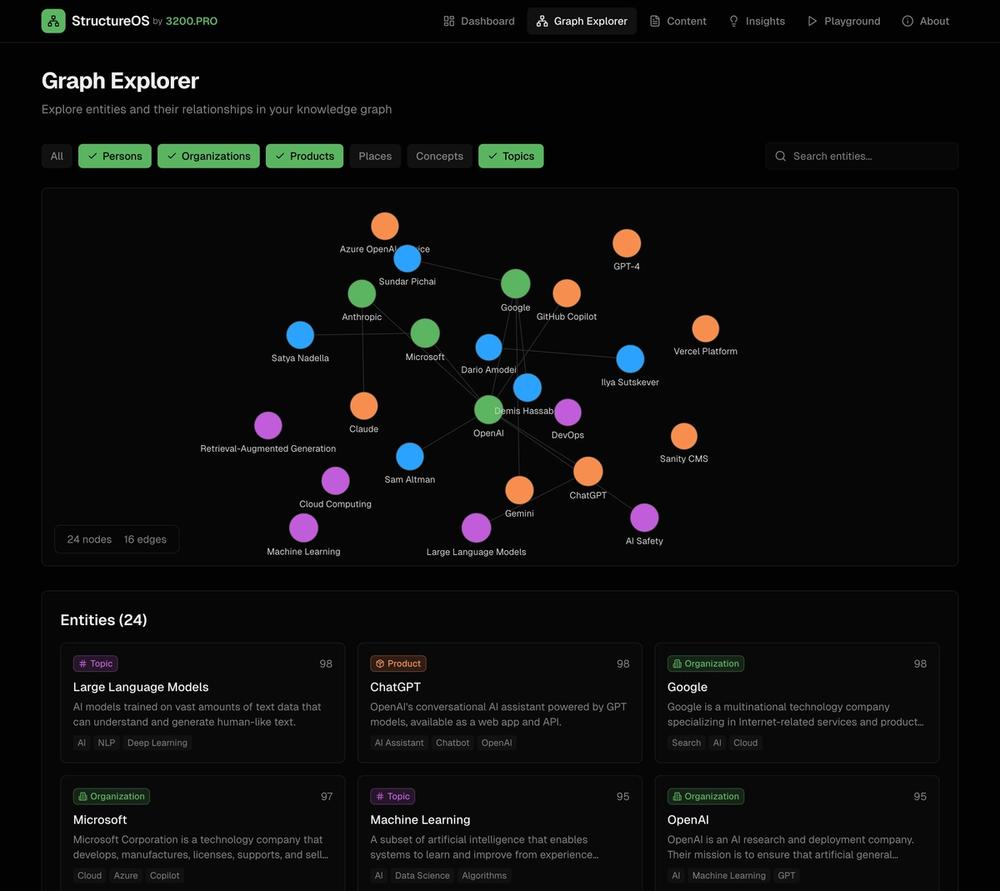
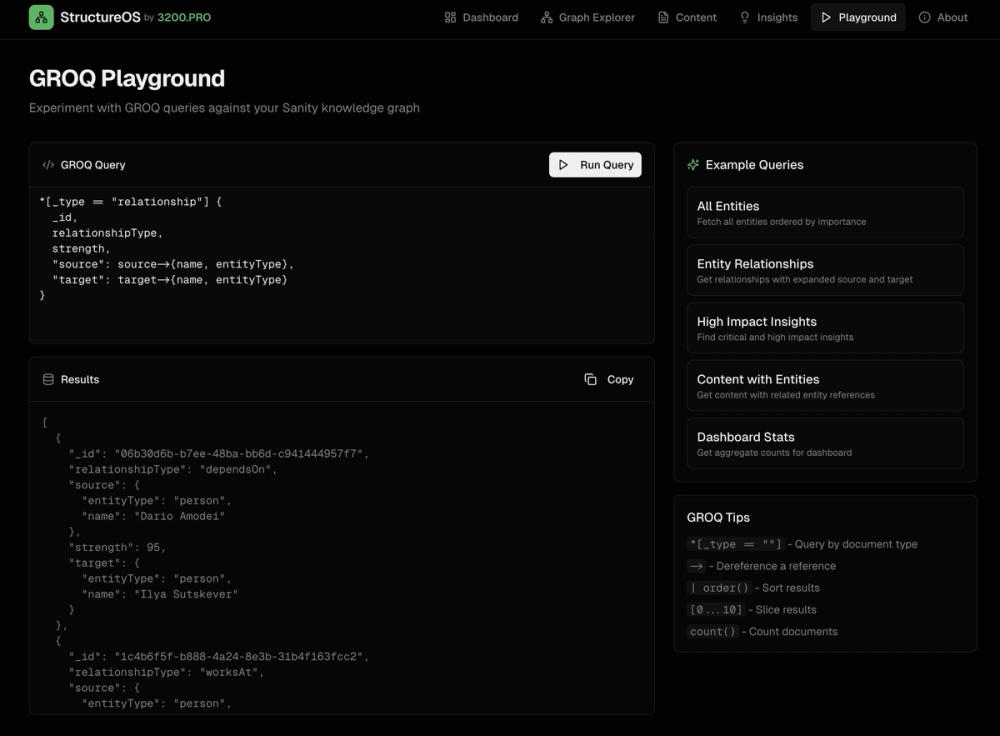
Instead of authoring pages and wiring them together manually, structure is modeled directly. Pages and features are derived from that structure using queries rather than hardcoded logic. While the connectivity can be viewed in the graph, filterable options and the query results are available in the StructureOs sandbox.
Data Model Overview
StructureOS is intentionally non-vertical. The same data model supports marketing sites, documentation, ecommerce, and internal tools.
Entity
Represents anything meaningful, including topics, products, organizations, people, places, and abstract concepts. Entity type is a field rather than a separate schema, enabling flexible reuse.
Relationship
Connects two entities and defines how they relate. Each relationship includes type, direction, strength, and contextual explanation. This transforms the dataset into a knowledge graph.
ContentNode
Represents any publishable artifact such as an article, landing page, documentation entry, or case study. Content nodes reference entities instead of embedding structure.
Attribute
Reusable descriptors that apply across entities, such as SEO-critical, performance-related, or trust-and-legal.
Insights
Documents that surface derived findings such as clusters, orphaned entities, internal linking opportunities, and content gaps. Insights are driven by queries over the graph.
This model avoids traditional tagging systems. Structure emerges from relationships rather than taxonomy.
Additional Project Info.
All product features are powered by GROQ queries over structured content.
Automatic Entity Pages
Every entity automatically generates a page that displays related entities, related content, and contextual explanations for why those relationships exist.
Internal Linking Intelligence
Content nodes do not store links. Linking opportunities are computed based on shared entities and relationship strength. When relationships change, internal links update across the site.
Topic and Entity Clusters
Clusters are derived by traversing dense relationship graphs. This reveals natural content groupings without manual categorization.
Orphan Detection
Entities and content with weak or missing connections are identified automatically. This highlights structural gaps rather than relying solely on traffic metrics.
Explainable Logic
Each derived view includes a plain-language explanation describing how the result was generated. This makes the system transparent and debuggable.
Built With
Structured content powered by Sanity, agent-driven development using v0, and production deployment on Vercel.
Thanks for taking a look ❤️ - Ryan Murray, 3200.Pro